 English




See how Luigi's Box can make your e-commerce search & discovery exceptional.

Sometimes your existing website search solution doesn’t quite cut it. While Vertex AI Search is a powerful tool, other solutions might better suit your business needs.
However, when you’re picking a Vertex AI Search alternative, the number of options can become overwhelming. Scrolling through product websites, each highlighting their accomplishments, and pondering over often confusing pricing structures takes a lot of time and effort.
To lift this burden off your shoulders, we have prepared an article that introduces the top 8 Vertex AI Search competitors. But that is not all. We are going to look at their features, pros and cons, as well as pricing to help you make the best-educated decision.
Why companies need advanced site search & discovery
You might be asking yourself why your e-commerce business needs a search solution anyway. Let’s go over the most pressing reasons why you should invest in e-commerce search and discovery software.
Improved customer experience through precision and speed
Customers don’t appreciate their time wasted. They value convenience, speed, and streamlined experiences.
Advanced website search solutions use algorithms to deliver results almost instantly. Additionally, using AI and natural language processing helps the software understand users’ search intent and retrieve highly relevant results even for vague or complex queries.
This reduces friction during the shopping process, leading to improved satisfaction and loyalty to your brand.
Higher conversion rates with personalization
63% of marketers in the U.S. claim that an increased conversion rate is the top benefit of personalization. AI-driven search can analyze user behavior and deliver tailored results that fit customers’ exact needs.
Besides allowing shoppers to quickly find relevant items, you can also recommend products a particular customer might enjoy. This results in higher average order values through upselling and cross-selling. Additionally, eliminating “No Results” pages by suggesting trending or related products helps ensure shoppers don’t leave your store empty-handed.
KiK: A real-world example of how a search solution makes a difference
KiK, a prominent German discount retailer, implemented Luigi’s Box Search and Analytics. This enhanced search accuracy, introduced advanced analytics, and allowed effective product merchandising and ranking.

KiK’s search results before implementing Luigi’s Box Search.
Using Luigi’s Box led to a 27% increase in direct conversion rates, a 14% rise in assisted conversions, and a 31% boost in average cart value. Overall, KiK’s online shopping experience improved significantly, with a 55% increase in total cart value.

KiK’s optimized website retrieves relevant results that lead to conversions.
Increased customer retention
When you create seamless customer experiences, they are more likely to continue shopping with you. If you want to keep your customers engaged and willing to spend more, optimizing their experience is a must.
Data supports this, as 80% of consumers said they exited a website due to a poor search experience.
Gain insights through analytics
Analytics are often an integral part of advanced website search tools. They allow you to track what users search for, what they click on, and what they struggle to find. Based on this behavioral data, you can identify trends, remove bottlenecks, prevent gaps in inventory, and even introduce new products or content that addresses customers’ needs.
Key search features to consider
When picking a Vertex AI Search alternative, having a list of the most important features comes in handy. Here are the tools your new website search & discovery solution should include.
Full-text search
Full-text search allows your search solution to retrieve results that contain all or some of the words from a user’s query. It allows them to search for specific words, phrases, or terms within product descriptions, titles, metadata, and other textual content.
This allows for more precise searching even with complex queries. Additionally, users do not have to alter their language to perform effective searches, and they have a more intuitive experience.
Autocomplete and predictive search
These features suggest search terms or specific products as users type, making the experience more streamlined. Additionally, they help reduce errors, making searches more effective.
Naturally, users enjoy having these options available. In fact, autocomplete can increase your online sales by up to 24%.
Natural Language Processing (NLP)
In a nutshell, NLP allows search engines to understand user intent and the context behind their queries. This significantly improves accuracy.
For example, think of a conversational query, such as “shoes for running in winter”. Instead of returning results for generic running shoes or unrelated winter footwear, the website retrieves results for insulated, waterproof running shoes. This is possible thanks to NLP interpreting the intent—running shoes that are suitable for winter.
Synonym and typo handling
Users often make small spelling mistakes or use alternative terms when searching for products. Synonyms and typo-handling features ensure they receive relevant results despite errors or different terminology.

Alza’s site search retrieving results for a keyword phone and its synonyms, such as a smartphone.
Personalized recommendations
Providing your customers with personalized product recommendations is invaluable. It not only encourages upselling and cross-selling, but it also significantly impacts customer experiences and improves retention. Data shows that 56% of online shoppers are more likely to return to a site offering tailored product suggestions.
Advanced analytics and reporting
When you consistently track search performance and customer behavior, you can make truly data-driven decisions. From identifying gaps to optimizing your offerings, using analytics data improves search functionality and leads to an improved shopping experience.
Front-end integration
Front-end integration enables you to embed the search engine directly into the user-facing components of your website. Why is this so important? This method is often done without coding on your part, eliminating the need for an entire IT team to carry out software implementation.
Mobile optimization
In 2023, approximately 30% of global online shoppers globally used mobile commerce on a weekly basis. This underscores the significance of your search solution working seamlessly on mobile devices.
Integrations
Think of integrations as a bridge connecting various software components (external applications, infrastructure, cloud services, etc.) into one unified ecosystem. They enable these components to communicate seamlessly, leading to more streamlined operations.
What is Vertex AI Search
Vertex AI Search is a feature within Google Cloud’s Vertex AI platform. It provides AI-driven search capabilities, specifically for enterprise use cases. As a part of Vertex AI Agent Builder, developers can use it to build search functionalities for websites, intranet, and retrieval-augmented generation (RAG) systems.
Besides being suitable for developers, Vertex AI Search is also a powerful tool for a range of use cases, including e-commerce, customer support, and internal knowledge management.
Vertex AI Search leverages advanced natural language processing and machine learning including vector search, to understand user intent and deliver highly relevant search results across structured and unstructured data.
As part of the Vertex AI platform, Vertex AI Search works best when integrated with other Vertex AI tools, such as Vertex AI Workbench, Vertex AI Pipelines, Vertex AI Models, Cloud Natural Language API, and more.
Overall, Vertex AI Search is a powerful tool designed to handle huge amounts of data. It offers a wide range of capabilities, making it a great option for large enterprises. Its advanced features are particularly suited for companies with the resources to invest in it.
Additionally, Vertex AI Search is best suited for businesses with strong internal IT teams that can manage the solution independently with minimum input from the provider’s customer support teams.
8 best Vertex AI Search competitors
So what else is out there? In the following sections, we are going to discuss the top 8 Vertex AI Search competitors, so you can pick one that best fits your business.
1. Luigi’s Box
Luigi’s Box is a well-known search and recommendation software provider tailored to e-commerce businesses. Officially launched in 2016, Luigi’s Box offers years of experience and expertise to deliver AI-powered solutions, helping more than 3,500 retailers skyrocket conversions in their e-shops.
Key features
Luigi’s Box’s advanced features span everything from faceted filtering to machine learning and behavioral recommendations.
- AI-driven Search
- Autocomplete
- Predictive Search
- Multilingual Search
- Typo correction
- Voice Search
- Search Analytics
- Artificial intelligence and machine learning
- Personalized product Recommender
- Dynamic filters
- Merchandising
- No-code self-service integration
Pros
- Seamless no-code integration
- Advanced AI Search and Autocomplete
- The solution is user-friendly and intuitive
- Personalized recommendations based on user behavior
- Responsive and reliable customer support
Cons
- In some languages, phrasing typo corrections can be tricky
- Occasional need for further configuration after the initial integration
Customer support
Luigi’s Box customer support is renowned for going the extra mile and treating each customer as a priority. They provide 24/7 customer service, and you can reach them through various communication channels, such as phone, email, and chat. If you wish to troubleshoot independently, there is a robust knowledge base full of informative guides. If you want to contact support, simply visit the Contact Us page.
Pricing
Luigi’s Box pricing depends on your requirements, page views, and the type of integration you prefer. This is a basic overview of pricing options for the Search:
- Self-Integration costs €140/month paid annually for 50,000 pageviews.
- For Custom Integration, contact Luigi’s Box’s team for a custom quote.
You can check out all the pricing plans to get a better understanding of all the options available.
2. Azure AI Search
Azure AI Search is an enterprise-grade knowledge retrieval system from Microsoft. It mainly powers advanced retrieval-augmented generation applications and enterprise search engines.

Azure AI Search—Microsoft’s enterprise information retrieval system.
Key features
- Indexing features
- Linguistic analysis
- Vector and hybrid search
- Applied AI and knowledge mining
- Free-form text search
- Filters and facets
- Programmability
Pros
- Many APIs augment the solution’s capabilities
- It offers customizable search capabilities
- It accepts a large variety of data sources for indexing
Cons
- The cost may be too high for small and even medium businesses
- The interface can be confusing with a steep learning curve
- Latency in responding to queries
Customer support
Azure AI services provide self-help resources in the Azure portal, various support plans, and community support via Microsoft Q&A and Stack Overflow. Users can submit feature requests through the Azure feedback portal and stay updated on any news through the Azure blog and updates.
Pricing
Azure AI Search’s products differ based on the region. Here are their main plans with prices specific to the Central US:
Free tier
- Storage: 50 MB
- Indexes: Up to 3
- Scale: Not available
- Cost: $0/month
Basic plan
- Storage: 15 GB (up to 45 GB per service)
- Indexes: Up to 15
- Scale: Up to 9 units (3 partitions, 3 replicas)
- Cost: $73.73/month
Standard plans (S1-S3)
- S1 Storage: 160 GB (up to 1.9 TB per service) – $245.28/month
- S2 Storage: 512 GB (up to 6 TB per service) – $981.12/month
- S3 Storage: 1 TB (up to 12 TB per service) – $1,962.24/month
- Indexes: 50-200 per service
- Scale: Up to 36 units (12 partitions, 12 replicas)
Storage-Optimized plans (L1 & L2)
- L1 Storage: 2 TB (up to 24 TB per service) – $2,802.47/month
- L2 Storage: 4 TB (up to 48 TB per service) – $5,604.21/month
- Indexes: Up to 10
- Scale: Up to 36 units (12 partitions, 12 replicas)
3. Coveo
Established in 2006, Coveo is a well-known AI search and recommendation software. They aim to help large enterprises become business-to-person and tap into the experience economy using AI.

Coveo—experience-oriented search software.
Key features
- AI-powered recommendation engine
- Advanced search and ranking
- Natural language processing
- Real-time reporting and analytics
- Autocomplete
- Merchandising capabilities
- AI and machine learning
Pros
- Seamless integration with Salesforce
- Convenient and useful dashboards
- Fast and reliable customer support
Cons
- The pricing can be too steep for smaller businesses
- Occasional index issues yielding insufficient result
- Sometimes vague queries yield irrelevant search results
Customer support
Coveo offers extensive self-service resources such as documentation, community forums, and training materials. Premium customers receive support from dedicated customer success managers and enjoy faster response times. Support is available through email, a ticketing system, and a support portal, with phone assistance for high-priority cases in higher-tier plans.
Pricing
Coveo offers two main pricing tiers.
- Pro: 100K queries per month with three cloud connectors.
- Enterprise: unlimited cloud connectors with deep learning capabilities.
Both plans come with custom pricing.
4. Amazon Kendra
Amazon Kendra is an AI-powered enterprise search service by AWS. Kendra integrates with various data repositories, such as file systems, databases, and cloud storage, making it easier to search for information scattered throughout the cloud.

Amazon Kendra—enterprise search engine from AWS.
Key features
- Intelligent search
- Generative AI
- Incremental learning
- Domain optimization
- Search analytics dashboard
- Query autocompletion
- Connectors
Pros
- The solution is highly scalable
- Pre-built industry-specific search templates
- The system is very stable and reliable
Cons
- It can be too expensive for businesses with large query volumes
- Slower response times and proactive support for lower-tier plans or complex issues
- The learning curve is often fairly steep
Customer support
Amazon Kendra is supported through AWS’s support system, which offers multiple support plans:
- Developer Support
- Business Support
- Enterprise On-Ramp
- Enterprise Support
Additionally, users can access self-help resources, submit support cases through the AWS Support Center, and leverage AWS Partner Network (APN) consultants for specialized guidance.
Pricing
Amazon Kendra’s pricing is based on the number of documents and queries you need. They offer three main pricing plans:
- The GenAI Enterprise Edition costs $0.32 per hour for basic storage and queries, with up to 20,000 documents or 200 MB of extracted text.
- The Basic Enterprise Edition costs $1.4 per hour for up to 100,000 documents or 30 GB of extracted text.
- The Basic Developer Edition costs $1.125 per hour for up to 10,000 documents or 3 GB of extracted text.
There are additional charges for extra storage and queries, and a $30 per month fee for using connectors.
The Basic Developer Edition and the GenAI Enterprise Edition plans come with a free trial that provides free usage of up to 750 hours for the first 30 days.
5. Dataiku
Dataiku is a platform for Everyday AI established in 2013. This collaborative AI platform helps businesses work with data more efficiently. Dataiku integrates with different data sources and provides visual interfaces for creating data pipelines.
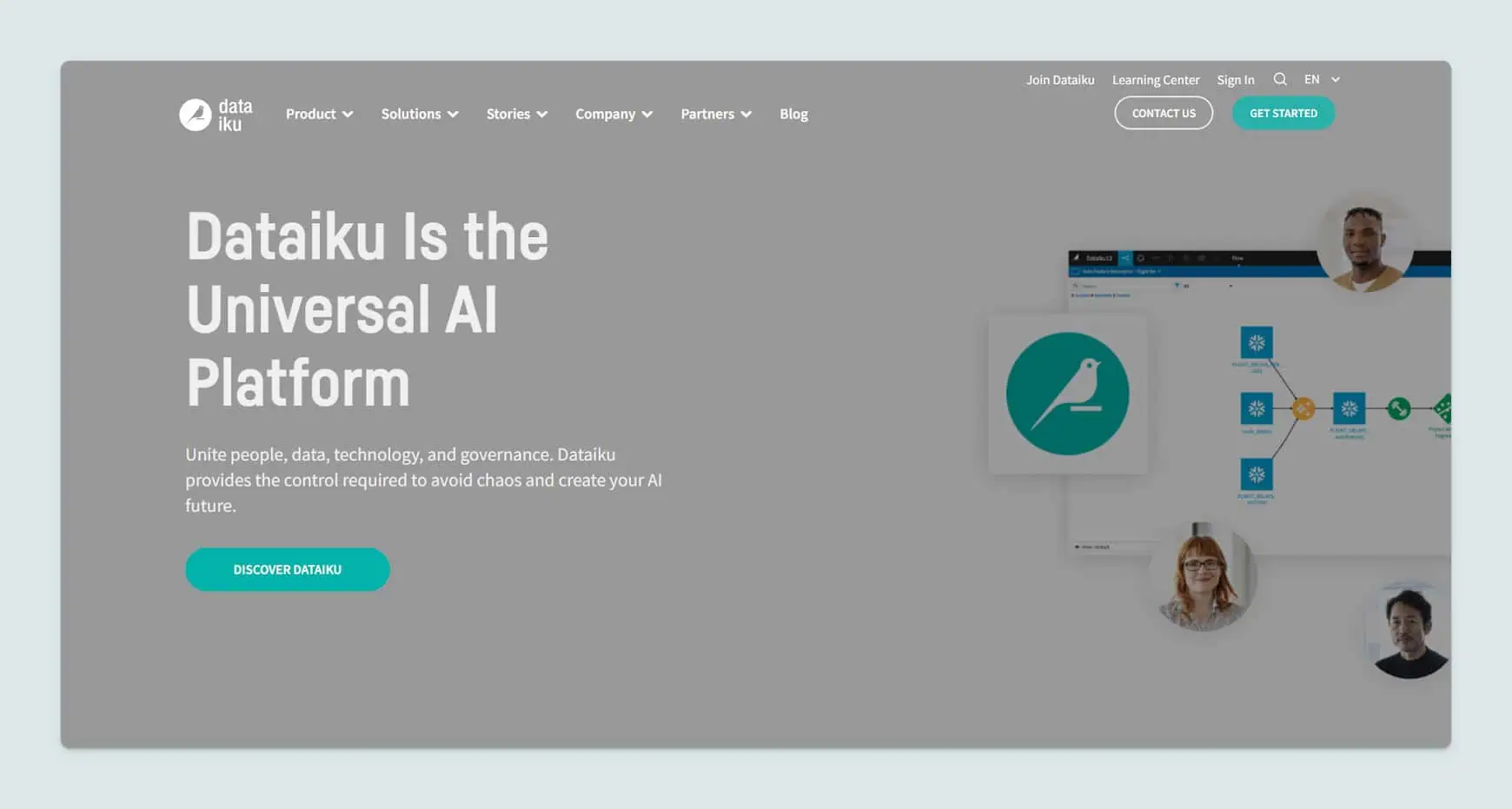
Dataiku—Everyday AI platform.
Key features
- Generative AI
- Machine learning
- MLOps (Machine Learning Operations)
- Data visualization
- Analytics
- REST API
- Encryption
Pros
- Visualization makes working with data easier
- The interface is user-friendly
- Data flow automation is easy and efficient
Cons
- It can be fairly complex to set up
- Some advanced features require knowledge of data science and programming
- Occasional outages can be disruptive
Customer support
Dataiku offers comprehensive customer support through several channels. Their support includes access to a knowledge base full of articles, documentation, and FAQs. They also provide email support for issues that require more personalized assistance. Additionally, Dataiku offers professional services such as consulting and training, as well as a community forum where users can collaborate and exchange insights.
Pricing
Dataiku offers three main pricing options:
- Free Trial of Dataiku Cloud for 14 days
- Free Edition with up to 3 users on Mac, Linux, or virtual machines
- Paid Editions require you to reach out to Dataiku’s sales team to get a quote
6. Algolia
Algolia is a French software company that helps businesses provide optimized search experiences on their websites or apps. Since 2012, Algolia has established itself as a heavy hitter in the world of SaaS.

Algolia—a well-known website search solution.
Key features
- Full-text search
- Highlighting and snippeting
- Advanced language processing
- Typo tolerance
- Geo-awareness
- Faceting and filtering
- Personalization
Pros
- Extensive documentation and helpful resources
- Quick search results delivery
- Fast and reliable customer support
Cons
- The initial setup can be quite complex
- It can be quite expensive for smaller businesses
- Insufficient customization options
Customer support
Algolia’s customer support is available through email with standard response times. Higher-tier pricing plans offer premium support, including 24/7 email and phone assistance, faster response times, and dedicated support engineers. Additionally, Algolia offers extensive documentation and a community forum for users who prefer self-help options.
Pricing
Algolia’s services are available in four main pricing plans. Each of them includes features from previous tiers, plus additional ones.
- Build: Includes up to 10,000 search requests per month. This tier is free.
- Grow: This tier is free or pay-as-you-go, based on your usage.
- Premium: Includes AI features and merchandising. Reach out to Algolia’s team to get a quote.
- Elevate: Includes full AI offering including NeuralSearch. Reach out to Algolia’s team to get a quote.
7. Databricks
Founded in 2013, Databricks serves as a unified analytics platform that enables data scientists, engineers, and analysts to collaborate on big data and AI projects. This open-source platform is mostly used for big data analytics, data science, and machine learning tasks across various industries, including healthcare, manufacturing, and entertainment.

Databricks—AI-powered analytics platform.
Key features
- Artificial intelligence
- Machine learning
- Data warehousing
- Real-time analytics
- Business intelligence
- MLflow pipelines
- Delta Lake (data engineering)
Pros
- Seamless integration with a wide range of cloud services
- Robust and useful documentation
- It supports notebook versioning with GitLab
Cons
- The platform can be confusing for new users
- It lacks visualization options
- Occasional performance issues
Customer support
Databricks offers various support plans, including Business, Enhanced, Production, and Mission Critical. Higher-tier plans provide 24/7 support, faster response times (within 15 minutes for critical issues), and proactive monitoring. Support includes access to a dedicated messaging channel for troubleshooting. The number of technical contacts and support hours varies based on the plan.
Pricing
Databricks offers a pay-as-you-go pricing model with no upfront costs. You pay for the products you use based on per-second granularity. The platform covers various products such as Data Engineering, Data Warehousing, Interactive Workloads, and Generative AI, each priced differently (e.g., Data Engineering starts at $0.15/DBU, Generative AI at $0.07/DBU).
Additionally, Databricks provides discounts for larger usage commitments through Committed Use Contracts. There are also add-ons for services like data transfer, storage, and collaboration.
8. Qdrant
Qdrant is an open-source vector search engine designed for high-performance similarity search. It helps developers build applications that can efficiently search and retrieve vectorized data, such as text, images, or other multimedia, based on their semantic similarity.

Qdrant—open-source vector AI search solution.
Key features
- Semantic search
- Multimodal search
- Recommendation system
- Multi-vector support
- Anomaly detection
- Hybrid search for text
- Advanced indexing
Pros
- The software is very quick and responsible
- The platform is developer-friendly, with an intuitive API
- Versatility thanks to the hybrid search capabilities
Cons
- The built-in features can be limiting to some
- Potentially complex setup for large deployments
- Occasional documentation gaps
Customer support
Developers can access assistance and collaborate with others via Qdrant’s active Discord server. Users can email the dedicated support team for Qdrant Cloud-related issues. General inquiries submitted through the contact form are typically answered within 48 business hours. Additionally, Qdrant provides documentation and tutorials.
Pricing
Qdrant offers three pricing models:
- Managed Cloud: Starts at $0 with a free 1 GB cluster. It provides fully managed services, including high availability, backup, disaster recovery, and zero-downtime upgrades.
- Hybrid Cloud: Starting at $0.014 per hour, this tier allows users to connect their own clusters (from any cloud, on-premise, or edge locations) to Qdrant’s managed services.
- Private Cloud: Pricing is custom and available upon request. This option provides full control by deploying Qdrant on-premise or air-gapped infrastructure for maximum data sovereignty. It includes all Hybrid Cloud features with complete autonomy over database clusters.
Conclusion
While Vertex AI Search has many powerful features and great qualities, it simply doesn’t work for some businesses. Using the right search solution can be truly transformative for your conversions, ROI, and customer relationships.
You can use this article as a guide to help you asses each solution’s unique strengths, features, and pricing structures. Whether you pick an e-commerce powerhouse like Luigi’s Box, an enterprise giant like Azure AI Search, or a developer-friendly open-source solution like Qdrant, there is something for every business need.
Frequently asked questions
Who are Vertex AI's competitors?
Vertex AI’s competitors include solutions like Luigi’s Box, Azure AI Search, Coveo, Amazon Kendra, and Algolia. These platforms offer advanced AI-driven search, personalization, and analytics features that can be used across various industries.
Is IBM Watson a search engine?
IBM Watson is not primarily a search engine, however, it offers AI-powered solutions for data analysis, natural language processing, and machine learning. It provides advanced tools for building intelligent search functionalities through its Watson Discovery service, which helps businesses find insights from large amounts of unstructured data.
What is the difference between Gemini and Vertex AI?
Gemini and Vertex AI are both AI platforms, but they serve different purposes. Gemini, developed by Google DeepMind, focuses on advanced generative AI and language models. In contrast, Vertex AI, also by Google Cloud, is a comprehensive machine learning platform designed to help businesses build, deploy, and scale AI models, with a strong emphasis on custom ML workflows and enterprise solutions. While Gemini excels in generative AI, Vertex AI is more tailored to scalable, data-driven applications.
What are the disadvantages of Vertex AI Search?
One disadvantage of Vertex AI Search is its complexity, requiring a strong internal IT team to manage and customize it. Additionally, it may be too expensive for small to medium-sized businesses, especially when scaled up for large datasets. The platform also relies heavily on integration with other Google Cloud tools, which may not be ideal for companies looking for an independent or multi-cloud approach. Some users also report a steep learning curve when configuring and optimizing the search functions.

E-Merchandising Software That Will Boost Your E-Shop Revenue
E-merchandising software shows relevant products at the right time. Learn how to leverage them to increase your businesses' earnings.

Why My E-Shop Needs Product Recommendation Software
Retaining customers is more challenging than ever. Learn how to keep them interested with personalized product recommendation software.
Martina is a caffeine-fueled content writer with a background in tech and creative writing. When she's not crafting content for Luigi’s Box, Martina enjoys exploring nature, reading, art, all things geeky, and making wonky crochet and knitted items.
More blog posts from this author